NetPractice

NetPractice

Mental Fitness for SSC CGL: 5 Habits That Actually Work

First, Let’s Be Clear: SSC CGL Isn’t Just About Studying Hard

Everyone talks about “how many hours you study,” but almost no one talks about “how strong your mind stays through the grind.”
That’s where mental fitness comes in—and it’s often the invisible edge that separates qualifiers from quitters.

Luckily, building Mental Fitness for SSC CGL isn’t some mystical process. In fact, it’s way more doable than you think.

You don’t have to meditate in a cave and you don’t need superhuman willpower either.
Instead, you need a few small but powerful habits that sharpen your brain day after day.

1st Habit: Work In Short, Intense Bursts

Here’s the truth:
Those 5-hour non-stop study sessions you hear about? They sound impressive but are terribly inefficient.

Instead, work smart. Follow a 45-minute deep work sprint, where you push your focus fully, and then reward yourself with a 15-minute break.
This cycle respects how your brain naturally functions—and keeps you energized longer.

In short:
Building mental fitness for SSC CGL is not about who studies longest; it’s about who studies sharpest.

2nd Habit: 5-Minute “Reset Your Brain” Moments

Now, let’s be real.
No one has time for hour-long meditations while preparing for SSC CGL. But what you can do is reset your mind in just five minutes.

Here’s how you do it:

  • Find a quiet spot.
  • Close your eyes.
  • Breathe deeply and evenly.
  • Let go of the mental clutter.

That’s it. Five minutes, done right, can reboot your brain and improve your ability to absorb new information.

Bottom line:
Your mental fitness for SSC CGL strengthens not just when you study—but when you recover wisely.

3rd Habit: Treat Sleep Like It’s Part of Your Strategy (Because It Is)

Believe it or not, sleep is part of your syllabus.

While everyone else cuts down on sleep to cram more hours, you’ll be smarter. Protect your 6.5–8 hours of sleep like your entire career depends on it—because honestly, it does.

Remember:
No sleep = No memory retention = No exam success. Simple math.

Prioritize sleep, and you’ll watch your concentration, mood, and energy levels all shoot up—essential pillars of true mental fitness for SSC CGL.

4th Habit: Move Your Body to Wake Your Mind

Long hours at a desk? Sure.
But no movement at all? Big mistake.

Movement creates mental clarity. Tiny activities like a 2-minute stretch, a few squats, or even pacing around the room can flush out mental fog.

Pro tip:
Whenever you feel your mind drifting, move your body first. Then come back to studying.
You’ll notice a real difference.

And if you’re serious about mental fitness for SSC CGL, you’ll add these micro-movements into your routine without failed prep hours, train your body to send energy signals to your mind.

5th Habit: Win the First 30 Minutes of Your Day

This is non-negotiable.
Finally, the way you start your day often decides how you finish it.

Instead of grabbing your phone or rushing into study mode half-asleep, invest the first 30 minutes into your mind.

Here’s a quick, powerful routine you can try:

  • Light stretching or stepping outside for fresh air
  • Reading a few GK headlines or vocab words
  • Writing down your top 3 study goals
  • Mentally solving 5 simple math or reasoning questions

Why it matters:
Starting strong primes your brain to stay productive and confident all day long—a key part of sustaining mental fitness for SSC CGL in the long run.

Final Thoughts!

There’s no secret sauce, no “mental fitness gene” you’re missing.

The students who crack SSC CGL are not just hard-working — they’re mentally tough. They bounce back after bad mocks, they show up even on lazy days and they protect their energy like their life depends on it.

You can be one of them. And it starts with these five habits, repeated until they’re just who you are.

Train your mind, not just your memory. Download the NetPractice App today and practice smarter, faster, and fresher than ever.

You Might Also Be Interested In –

How To Bounce Back After a Bad Mock Test?
https://netpractice.app/ssc-cgl-bounce-back-after-bad-mock-test/

Can an Average Student Crack SSC CGL?

The short answer is: Yes. But only if you stop believing the myth that only ‘toppers’ or ‘genius-level minds’ can clear competitive exams. The long answer to “can an average student crack SSC CGL?” Read on. If you’ve ever thought, “I’m just average, I probably can’t make it,” this blog is for you. Because the truth is, the SSC CGL exam is more about consistency, clarity, and astute effort than it is about genius.

1. In SSC Prep, What Does “Average” Actually Mean?

Because they struggled in school or didn’t place in the top 10%, the majority of applicants call themselves “average.” However, SSC CGL does not seek exceptional skills. Students who are able to:

  • Understand concepts well
  • Regularly practice questions
  • Stay calm under pressure
  • Have a well-thought-out plan

So when we ask, “can an average student crack SSC CGL?” ” in reality, we want to know if a dedicated, consistent student can succeed. An the answer is – Absolutely.

2. Real Talk: What You Need (And What You Don’t)

You don’t need:

  • Coaching from day one
  • A high IQ
  • To study 12 hours a day

You do need:

  • A reliable plan (not one copied from a topper blindly)
  • 3–5 focused hours a day
  • Daily practice + weekly mocks

3. Break It Down: The SSC CGL Syllabus Isn’t Rocket Science

What makes it possible is this:

  • Quant: Quant: Predicated on math from class 10. Anyone can become proficient in DI, algebra, and simplification with practice and clever tips.
  • Reasoning: This is purely practice-based and involves patterns, coding-decoding, and riddles.
  • English: With reading and revision, vocabulary, grammar, and comprehension all gradually get better.
  • GK: Static GK + Current Affairs—easy to recall with revision and mnemonics.

Still wondering can an average student crack SSC CGL? Keep in mind that these parts assess discipline rather than intelligence.

4. Smart Habits > Raw Intelligence

Top techniques employed by “average” students who passed the SSC CGL:

  • Limit your sources to one or two (not 10 books).
  • Use PYQs as the most important method. (most questions are repeated)
  • Daily goals rather than long days
  • Every Sunday, do one mock and go over it carefully.
  • Steer clear of social media distractions.

5. Real Success Stories Speak Louder

Many SSC officers today were once ‘average’ students. They simply followed one golden rule: “Start where you are, use what you have, do what you can—daily.”

If you’re still asking yourself, “can an average student crack SSC CGL?”—remember, it’s not about where you start, but whether you keep showing up.

6.’Average’ Minds Time-Saving SSC CGL Tricks

  • While commuting, review GK using voice notes.
  • Use a 90-minute block study schedule that includes breaks.
  • Convert difficult subjects into mind maps or visual notes.
  • Use reverse learning: attempt mock, then go study what you got wrong.

Final Thoughts!

If you’ve got the will, a basic study plan, and the courage to keep going—even after bad days—then you already have what it takes.

Stop asking can an average student crack SSC CGL? and start preparing like someone who knows the answer is YES.

AND! Start practicing smarter, not harder. Download the NetPractice App and build your SSC CGL prep muscle—one smart session at a time.

You Might Also Be Interested In –

Funniest GK Mnemonics that you will never forget!

https://netpractice.app/easy-ssc-cgl-gk-mnemonics/

SSC CGL GK Mnemonics You Won’t Forget (Cz They’re Funny)

Let’s be honest — Static GK is boring. And dry facts? Even worse. But what if there was a way to laugh and learn at the same time?

Enter: Mnemonics — the one trick your brain actually enjoys using. And no, not the serious, textbook-style ones. We’re talking about clever, ridiculously funny lines that stick in your head without effort.

In this blog, we’ll cover the Top 20 SSC CGL GK Mnemonics that will help you ace Static GK with a grin on your face.

What Makes a Good GK Mnemonic?

  • It should make you laugh.
  • It must be absurd enough to be memorable.
  • And most importantly — it should help you recall actual facts.

All of the Top 10 SSC CGL GK Mnemonics below are pulled from real, high-weightage topics from PYQs (Previous Year Questions).

Top 20 SSC CGL GK Mnemonics (Funny but Super Useful)

1. Seven Continents

Mnemonic: Elder Aunt Always Eats North South Apple Australia
Breakdown: Europe, Asia, Africa, North America, South America, Antarctica, Australia

2. G20 Countries

Mnemonic: Big Fat Ice Cream Made India’s Sweet Tooth Tingle Greatly
Breakdown: Brazil, France, Italy, China, Mexico, India, South Africa, Turkey, Germany
(Use your own silly extension for full 20 if needed.)

3. Planets (in order)

Mnemonic: My Very Educated Mother Just Served Us Nachos
Breakdown: Mercury, Venus, Earth, Mars, Jupiter, Saturn, Uranus, Neptune

4. East-Flowing Rivers in India

Mnemonic: God Gave Me Krishna’s Cake
Breakdown: Godavari, Ganga, Mahanadi, Krishna, Kaveri

5. States that share borders with China

Mnemonic: All Aunts Have Seen Mom’s Touchy Anklets
Breakdown: Arunachal Pradesh, Assam, Himachal Pradesh, Sikkim, Manipur, Tripura, Aksai Chin (Note: India considers Aksai Chin as its own.)

6. Mughal Emperors

Mnemonic: Bad Hungry Akbar Just Said Amazing
Breakdown: Babur, Humayun, Akbar, Jahangir, Shah Jahan, Aurangzeb
(Weird story? Yes. But you’ll never forget it.)

7. Fundamental Rights (Article 12–35)

Mnemonic: Every Funny Rat Eats Red Chili Rice
Breakdown: Right to Equality, Right to Freedom, Right against Exploitation, Right to Freedom of Religion, Cultural and Educational Rights, Right to Constitutional Remedies

8. NATO Countries (selected ones for quick recall)

Mnemonic: Never Forget Germany’s Salty Turkey Pizza
Breakdown: Norway, France, Germany, Spain, Turkey, Portugal

9. First 5 Presidents of India

Mnemonic: Red Prince Zakir Voted Girl Rock
Breakdown: Rajendra Prasad, Sarvepalli Radhakrishnan, Zakir Hussain, V.V. Giri, Fakhruddin Ali Ahmed

10. UNESCO Sites in India (Most Asked)

Mnemonic: Tagore’s Sun Temple Made Elephants Dance in Ajanta
Breakdown: Tagore (Santiniketan), Sun Temple (Konark), Elephanta Caves, Ajanta Caves
(These repeat often in SSC GK section!)

11. Major Himalayan Ranges (from South to North)

Mnemonic: Shiwalik’s Heart Beats Loudly

Breakdown: Shiwalik, Himachal, Greater Himalayas (Himadri)

12. First 4 Nobel Laureates from India

Mnemonic: Rabindranath Cared Motherly About Peace
Breakdown: Rabindranath Tagore (Literature), C.V. Raman (Physics), Mother Teresa (Peace), Amartya Sen (Economics)

13. Six Classical Dances of India

Mnemonic: Big Cats Kill Otters Like Monkeys
Breakdown: Bharatnatyam, Kathak, Kathakali, Odissi, Lavani, Manipuri

14. Largest Deserts

Mnemonic: Alice Screamed in Scary Arabian Nights
Breakdown: Atacama, Sahara, Sonoran, Arabian, Namib

15. ISRO Launch Sites

Mnemonic: They Use Secret Sriharikota Points
Breakdown: Thumba, Udhampur, Sriharikota, SHAR, Port Blair

16. Nuclear Power Plants in India

Mnemonic: Can Raw Bananas Make Tea Kindly?
Breakdown: Kalpakkam, Rawatbhata, Kakrapar, Narora, Tarapur, Kudankulam

17. Important Battle Years

Mnemonic: Plassey Bumped Buxar in 1757-1764
Breakdown Battle of Plassey (1757), Buxar (1764)

18. Important Mountain Passes

Mnemonic: Joe Ran Naively By Zoji
Breakdown: Jelep La, Rohtang, Nathula, Baralacha, Zoji La

19. Countries of SAARC

Mnemonic: My Brother Is Picking Nice Baked Apples From Sri Lanka
Breakdown: Maldives, Bangladesh, India, Pakistan, Nepal, Bhutan, Afghanistan, Sri Lanka

20. Monsoon Months

Mnemonic: Jumping Jolly August Brings Rain
Breakdown: June, July, August, September

How to Make Your Own GK Mnemonics?

Now that you’ve laughed your way through the Top 20 SSC CGL GK Mnemonics, here’s how you can cook up your own:

  1. Use Your Native Language – Mix in Hindi, Tamil, Bengali… whatever makes it stick!
  2. Add Personal Jokes – Inside jokes are memory gold.
  3. Keep It Weird – The stranger, the stronger.
  4. Visualize It – Turn each line into a mental scene.

Final Thoughts!

Look — GK isn’t going anywhere. But how you tackle it can make all the difference.

By using these Top 20 SSC CGL GK Mnemonics, you’ll not only remember key facts more easily, but you’ll also spend less time cramming and more time revising.

Also, master SSC CGL GK faster with the NetPractice App — smart quizzes, fun tricks, and daily practice in one place.

You Might Also Like To Read-

Top 10 SSC CGL Scoring Topics!

https://netpractice.app/top-10-ssc-cgl-scoring-topics/


Top 10 SSC CGL Scoring Topics (PYQ Based)

Why You Shouldn’t Study Everything Equally?

Let’s be honest — SSC CGL has too much syllabus and not enough time. If you’re trying to cover everything equally, you’re already at a disadvantage. Smart toppers don’t do that. They pick the right battles. This list of the Top 10 SSC CGL Scoring Topics is based entirely on a deep analysis of previous year papers. No guesswork, no random tips. Just actual exam trends.

What Makes a Topic “Scoring”?

Here’s what we looked at to pick these:

  • Frequency across at least 4+ past year Tier 1 papers
  • Questions that are repeatable, formulaic, or pattern-based
  • High accuracy potential even under time pressure
  • Not concept-heavy like advanced math or tricky puzzles

These are the low-hanging fruits you must grab first.

Top 10 SSC CGL Scoring Topics (PYQ Proven)

1. Simplification & Approximation – Quant

  • Why it’s scoring: Most questions are basic BODMAS, decimals, or fractions.
  • Pattern: Usually 3-4 marks guaranteed.
  • Trick: Use Vedic math to boost your calculation speed by 2x.

2. Synonyms-Antonyms – English

  • Why it’s scoring: The vocabulary questions often repeat or come from predictable word banks.
  • Pattern: 2–3 questions per paper.
  • Trick: Maintain a personal vocab list from PYQs and revise it regularly.

3. Current Affairs – General Awareness

  • Why it’s scoring: Around 4-5 questions are pure current affairs.
  • Pattern: Focus on the last 6 months before your exam date.
  • Trick: Use monthly one-liner PDFs. Don’t go into newspapers unless you have the time.

4. Spotting Errors – English Grammar

  • Why it’s scoring: You either know it or you don’t. No grey area.
  • Pattern: 2-3 grammar-based error spotting questions.
  • Trick: Revise subject-verb agreement, articles, prepositions. That’s where 80% of errors come from.

5. Number Series – Reasoning

  • Why it’s scoring: Patterns are limited and repetitive.
  • Pattern: 1-2 questions. Takes under 30 seconds if you know the tricks.
  • Trick: Know common sequences — +/-, ×, squares, cubes, alternate numbers.

6. Data Interpretation – Quant

  • Why it’s scoring: Based on basic math — percentages, averages, ratios.
  • Pattern: Comes as a set of 3-5 questions.
  • Trick: Don’t calculate everything fully — estimate when possible.

7. Coding-Decoding – Reasoning

  • Why it’s scoring: Most questions are mechanical — follow a letter shift or pattern.
  • Pattern: 1–2 questions per set.
  • Trick: Learn the A=1 to Z=26 table by heart. It cuts your thinking time in half.

8. Modern History – Static GK

  • Why it’s scoring: Questions repeat a lot from the freedom movement section.
  • Pattern: 2–3 questions usually.
  • Trick: Don’t waste time on Ancient or Medieval. Focus only on 1857 to 1947.

9. One-Word Substitution – English

  • Why it’s scoring: Direct memory-based question. No ambiguity.
  • Pattern: 1–2 questions, frequently repeated.
  • Trick: Create flashcards from PYQs only. Don’t learn from generic vocab books.

10. Mensuration (2D & 3D) – Quant

  • Why it’s scoring: Formula-based questions. Once you memorize them, you’re set.
  • Pattern: 2–3 questions on cubes, cylinders, spheres, etc.
  • Trick: Create a formula sheet and revise it weekly. Practice visually with figures.

How to Practice These Topics Without Burning Out –

Here’s a weekly strategy to actually cover these Top 10 SSC CGL Scoring Topics:

DayFocus Areas
MonSimplification + Synonyms
TueSpotting Errors + Number Series
WedMensuration + Coding-Decoding
ThuCurrent Affairs + History
FriOne-word + DI
SatMock + Revision
SunPYQ Marathon

Stick to this for 3 weeks and track your accuracy. You’ll know your strong and weak zones in no time.

Final Thoughts!

You don’t need to master everything to crack SSC CGL. But you must master what matters most — and that’s exactly what these Top 10 SSC CGL Scoring Topics help you do.

This isn’t a “shortcut.” It’s about strategy. Solve what the exam wants you to solve

Want topic-wise mock tests focused only on these high-return areas?
Download the NetPractice App for curated quizzes, PYQs, and analytics — all built around the Top 10 SSC CGL Scoring Topics.

You Should Also Read –

SSC CGL Current Affairs vs Static GK

https://netpractice.app/ssc-cgl-current-affairs-vs-static-gk/

SSC CGL Current Affairs vs Static GK: More Marks in What?

If you’ve ever prepped for SSC CGL, you know this: General Awareness feels like a gamble. One day it’s about presidents, the next it’s about folk dances. So the burning question is: should you invest more time in SSC CGL Current Affairs or Static GK?

Let’s break it down—realistically and practically—with examples, smart tips, and a clear takeaway.

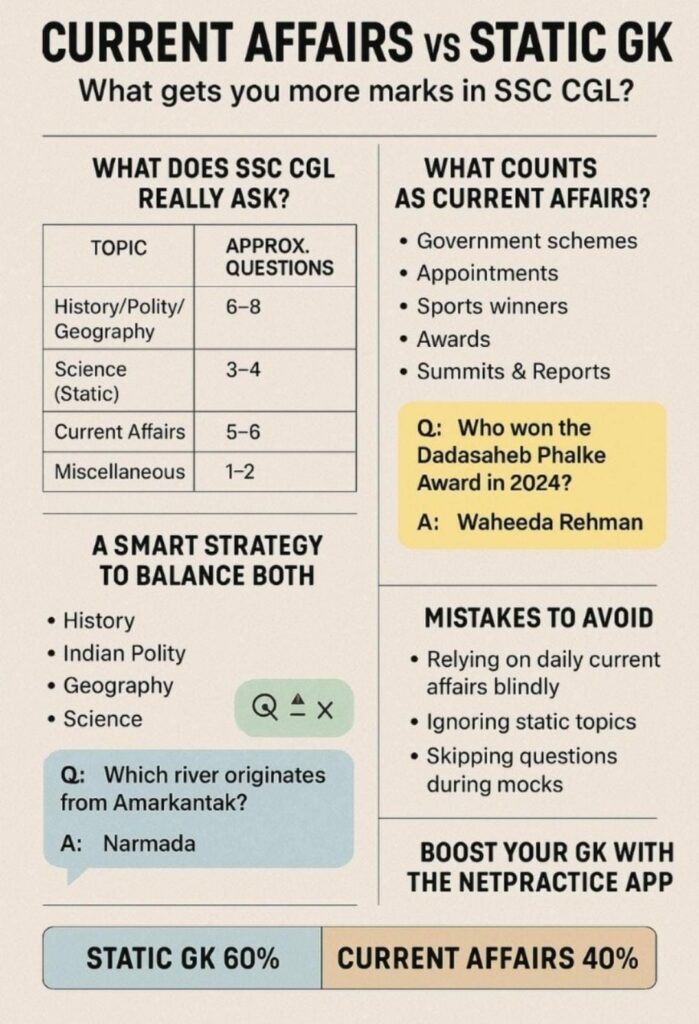
1. Really what does SSC CGL Current Affairs ask?

Recognize the trend before taking sides. Over the past few years:

  • Approximately 60–70% of the GA segment was contributed by static GK.

Here’s a rough breakup (based on recent shift-wise papers):

TopicApprox. Questions
History/Polity/Geography6–8
Science (Static)3–4
SSC CGL Current Affairs5–6
Miscellaneous1–2

2. Current Affairs : What Does It Mean?

Consider it as “recent events with SSC value,” rather than just any news story. Concentrate on:

  • Government schemes
  • Appointments (Chief Justices, Governors, etc.)
  • Sports winners (esp. Olympics, cricket)
  • Awards (Padma, Nobel, etc.)
  • Summits & Reports

Example:
Q: Who won the Dadasaheb Phalke Award in 2024?
Answer: Waheeda Rehman

3. The Reason Static GK Remains the Best

Static GK questions don’t change annually, however SSC CGL Current Affairs questions do. You benefit from every try, every year, once you’ve perfected it.

Topics to prioritize:

  • History (Modern India + Freedom Movement)
  • Indian Polity(fundamental rights, articles of the constitution)
  • Geography(States, Rivers, Capitals, Dams)
  • Science basics (Biology > Chemistry > Physics)

Example:
Q: Which river originates from Amarkantak?
Answer: Narmada

4. A Smart Strategy to Balance Both

Use a weighted approach rather than picking just one.

Static GK (60% prep time)

  • Take notes according to topics.
  • Every day, practice MCQs.
  • Make use of flashcards or mental maps.

SSC CGL Current Affairs (40% prep time)

  • Revise monthly PDFs (last 6 months minimum)
  • Practice your one-liners.
  • Follow a reliable source (don’t overdo it).

5. Real Preparation Timeline

Weeks LeftStatic GK FocusSSC CGL Current Affairs Focus
8–6 WeeksNCERTs + Subject NotesMonthly revision PDFs
5–3 WeeksPractice testsPractice tests + One-liners
2–1 WeekRevision & Quick notesCurrent Affairs crash review

6. Mistakes to Avoid

  • Relying on daily current affairs blindly
  • Ignoring static topics just because they’re “boring”
  • Skipping questions during mocks—you miss spotting patterns!

(Don’t forget to find and download the ultimate cheat-sheet at the end of the blog!)

Final Thoughts!

Static GK gives you stable marks.
SSC CGL Current Affairs gives you the edge.
Don’t ditch either, then. However, if you’re pressed for time, start with mastering static and then add intelligent current affairs revision.

Use the Netpractice App to Improve Your GK!

Do you need flashcards, one-liner drill, and rapid review for SSC CGL Current Affairs and Static GK? You can use the Netpractice app. Everything you require is in one location: daily multiple-choice questions, weekly practice GA sections, and a customized GK tracker.

You Might Also Like –

SSC CGL Cloze Test Practice Tips with examples

https://netpractice.app/ssc-cgl-cloze-test-practice-strategy/

SSC CGL Cloze Test Practice and Strategy (With Examples)

Let’s be honest. The SSC CGL Cloze Test is underestimated by most candidates. Just Fill in the blanks, isn’t that easy?

The catch is that a single incorrect word in that passage can affect your score as a whole. In contrast to fill-in-the-blanks or error spotting, a Cloze Test requires more than just grammar. It assesses your comprehension of the flow, tone, and context of English as it actually functions.

And for that reason, we’re going into great detail about the SSC CGL Cloze Test in this blog. You will receive shrewd tactics, examples, and mistakes to steer clear of. No fluff. No filler.

What’s a Cloze Test Anyway?

In the SSC CGL Tier 1 exam, a Cloze Test usually appears as a short passage with 5 to 10 blanks. Each blank has four options—you need to pick the one that best fits.

Now, it’s not just vocabulary. It’s about:

  • Reading comprehension
  • Understanding tone
  • Grammar accuracy
  • Logical flow

It’s like solving a mini puzzle—but the pieces are all words.

Why Is the SSC CGL Cloze Test Tricky?

Because it looks easy.

Most of us skim through the options and go with gut feeling. That works in movies—not here.

The real challenge? Often, two or more options seem correct. And unless you understand the passage as a whole, you’ll fall into the trap.

Your Strategy to Crack the Cloze Test –

Here’s a simple 5-step approach that works even if your grammar isn’t perfect:

Step 1: Read the Full Passage First

Don’t jump to the blanks, please. Read it as though it were a news item or a story. Understand the tone. Is this thing serious? Sarcastically? Educative? Finding the perfect words is much simpler if you “get” the feeling.

Step 2: Make a Word Prediction Before Viewing the Options

Before you look at the options, try to fill in the blank yourself. Follow your gut, but only after you’ve comprehended the sentence.

Why this works:
Your brain naturally completes sentences you’re familiar with. By using this technique, you can avoid becoming confused by options that look alike.

Step 3: Make Wise Use of Elimination

Now look over your options. Mark those that are out of tone or lacking proper grammar. Usually, you can eliminate 2 out of 4 right away. Look at connectors like “however,” “because,” or “although.” These are huge clues.

Step 4: Mind the Flow

Even if individual sentences make sense, the whole passage must read smoothly. If your chosen word makes the paragraph awkward, reconsider.

tep 5: Go over everything again.

Don’t skip this. Read the passage again from beginning to end after you have filled in all the blanks. If something doesn’t feel right, repair it.

Let’s See an Example (SSC CGL Cloze Test Style)

Passage:
The weather was gloomy, and clouds (1) the sky. People were rushing home, trying to (2) the heavy rain. Shops started closing early, and streets were soon (3).

Options for (1):
a) decorated
b) crowded
c) covered
d) ignored
Correct: covered

Why? Because “clouds” don’t decorate or ignore. “Covered” fits the visual image and the tone.

Follow the same logic for the rest. Use context, not just vocabulary knowledge.

Mistakes to Avoid in the SSC CGL Cloze Test

  • Don’t rely on the meaning of individual words. Think sentence-by-sentence.
  • Don’t rush. You have enough time if you’ve practiced.
  • Avoid picking what “sounds” right—go with what flows right in the passage.
  • Don’t guess based on just grammar rules—meaning matters more.

Quick Tips That Actually Help

  • Practice with previous year SSC CGL Cloze Test questions. The tone and complexity are pretty consistent over the years.
  • Read English editorials daily. They naturally teach you flow, connectors, and tone.
  • Keep a notebook of confusing words and transitions (e.g., although, despite, furthermore, hence).
  • Use apps or tools where you can get instant explanations when you go wrong.

Final Thoughts!

This section doesn’t demand you be a grammar nerd or vocab king. What it really wants is your ability to understand context and stay calm under pressure. Once you nail that, these SSC CGL Cloze Test marks are yours! And guess what? These are the fastest marks you can score in English if you get the hang of it.

Want Practice with Instant Feedback?

Try the NetPractice App

  • Practice Cloze Tests in exam-style format
  • Get explanations for every question
  • Track your progress, speed & accuracy

No more guessing. Just real-time learning.

You Might Also Like To Read-

SSC CGL Simplification and Approximation Questions Tips & Tricks!

https://netpractice.app/ssc-cgl-simplification-and-approximation-questions/

SSC CGL Simplification and Approximation Questions Made Easy

Why Simplification & Approximation Matter So Much in SSC CGL

Let’s be honest—when time is ticking in the SSC CGL exam, you want questions that take the least time and give the highest accuracy. And that’s exactly where SSC CGL Simplification and Approximation questions come in. Most aspirants treat them as “easy marks,” and that’s true—only if you’re prepared.

These questions test how well you handle numbers under pressure. If you’ve practiced well, they take less than 30 seconds each. If not, you’ll waste precious time recalculating what could’ve been done in your head.

What These Questions Typically Look Like

  • Simple numerical expressions
  • Fraction calculations
  • Square roots and cube roots
  • Approximating multiplications/divisions
  • BODMAS-based puzzles

They usually appear in both Tier 1 and Tier 2, and knowing how to simplify smartly can earn you 4–5 bonus marks.

Shortcuts That Work

1. The BODMAS Rule

That’s your golden rule—Brackets, Orders, Division/Multiplication, Addition/Subtraction. Always process in that order.

Example:

(36 ÷ 6) × (3 + 1) = ?
→ 6 × 4 = 24

2. Squares, Cubes & Tricks

Squares till 30 and cubes till 15 should be instant recall. No excuses here.

SquareCube
25² = 6255³ = 125
13² = 1699³ = 729

Pro tip: Know these like you know your phone number.

3. Use the Smart Round-Off Method

When precision isn’t necessary (like in approximation questions), round up or down to make life easier.

Example:

98 × 52 ≈ ?
Round: 100 × 50 = 5000
Choose the closest option to 5000. Done!

4. Split Large Fractions First

Don’t try to calculate everything at once. Break it down.

Example:

(1/2 + 1/3 + 1/6) = ?
Find LCM: 6
→ (3 + 2 + 1)/6 = 6/6 = 1

Easily marks could be gained.

5. Eliminate Options Intelligently

You don’t need to solve every question completely. SSC CGL often gives you 4 options far apart. Use common sense and basic rounding to eliminate the wrong ones.

What Not To Do –

  • Don’t ignore signs like “approx.” in questions
  • Don’t skip basics like LCM, HCF, or divisibility
  • Don’t recalculate the same step multiple times
  • Don’t round off when options are too close

How to Get Good at This –

  • Practice 15 questions daily from previous year papers
  • Keep a list of common calculation hacks
  • Use a timer while solving
  • Review your wrong answers immediately

Final Thoughts!

If you’ve been ignoring Simplification and Approximation thinking they’re “too basic,” it’s time to change your game plan. These are the low-hanging fruits of the SSC CGL exam.

So instead of chasing overly complex topics, make SSC CGL Simplification and Approximation your stronghold.

Power Your Prep with NetPractice App!

Get real SSC CGL-level questions, daily practice, smart analytics, and personalized feedback.
All of that (and more) is waiting inside the NetPractice App.
Install it now and unlock time-saving methods you won’t find anywhere else.

You Might Also Like –

SSC CGL Coding-Decoding Questions Pro Tips

https://netpractice.app/ssc-cgl-coding-decoding-tricks/

SSC CGL Questions: Coding-Decoding Top Patterns & Tricks

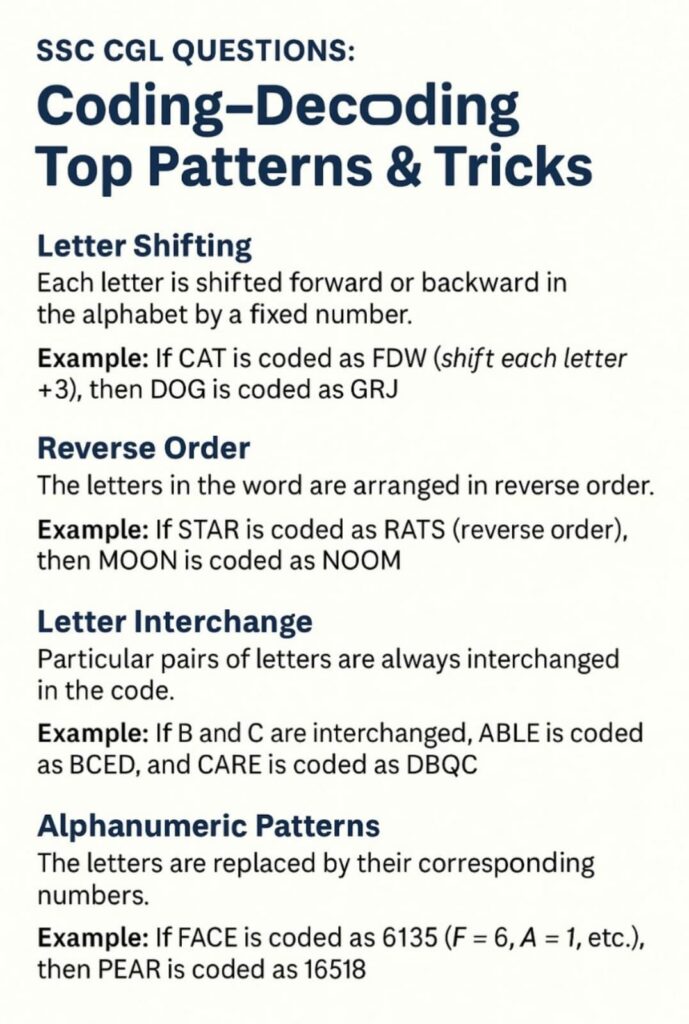
Gaining proficiency in coding-decoding is essential if you want to do well on the SSC CGL reasoning test. When approached correctly, these commonly asked SSC CGL questions can be answered in less than 30 seconds.

The best patterns, strategies, and practice advice that have helped thousands of candidates succeed are broken down in this blog.

Why Coding-Decoding Matters in SSC CGL Questions?

Both Tier 1 and Tier 2 papers that fall under the General Intelligence and Reasoning section use coding-decoding. Your final score increases significantly with each right response. However, candidates frequently waste too much time because they are unable to recognize patterns.

Knowing the different kinds of coding-decoding SSC CGL questions that are frequently asked and being able to decode them quickly are essential for success.

Top Coding-Decoding Patterns in SSC CGL Questions

Let’s dissect the most often used types together with quick tips and exercises.

1. Letter Shifting using alphabetic coding

Every letter moves a specified number of places.

Example:
If CAT is coded as FDW, for instance, C → F (+3), A → D (+3), T → W (+3).
Same for every letter.

Trick: Learn the alphabet positions: A=1, Z=26. apply forward/backward shifting reasoning.

2. Reverse alphabetical coding

The foundation of coding is the position from the reverse side of the alphabet.

Example:
If A=26, B=25… Z=1, then:
DOG → D(23) O(12) G(20)

Trick: Keep a reverse alphabet chart in your notes for daily reference.

3. Addition and subtraction based on positions

The alphabetical position values can be added or subtracted.

Example:
CAR → C(3)+A(1)+R(18) = 22
So CAR = 22.

Trick: Excellent for questions involving numerical codes. Practice doing quick calculations.

4. Coding from Number to Letter

Letter positions are represented by numbers or digits.

Example:
If 3 1 20 = CAT → C(3), A(1), T(20)

Trick:
Identify if the code is referring to shifts or letter positions.

5. Coding with Word Pairs

Code is created by examining the transformations of a pair of related words.

Example:
If PENRGP, then find the logic:
P → R (+2), E → G (+2), N → P (+2)

Trick: Determine the shift by examining each letter separately.

Crucial Tips for Solving Coding-Decoding SSC CGL Questions

  • Daily Practice: Muscle memory is developed by answering 5-10 questions every day.
  • Keep an Alphabet Chart: Pay particular attention to the A-Z number positions.
  • Look for Uniformity: The majority of SSC CGL questions have recurring themes, such as +1 or -2.
  • Eliminate Wrong Options: In cases where decoding takes longer, use option elimination.
  • Practice Mock Tests: Set a timer to mimic the actual exam.

Bonus: Take Part in This Coding-Decoding Task

If BOX = CLY, how is DOG coded?

Hint: Apply a shift after finding the opposite letters.

Before you check the answer, try decoding yourself!

Here’s a simplified cheat-sheet for you to ace!

Final Thoughts!

Pattern recognition and speed are the keys to mastering SSC CGL coding-decoding questions. You’ll be able to handle these questions with confidence and ease once you understand the most common types and use the tricks frequently.

Use the NetPractice app to begin practicing.

Do you want to improve your understanding of coding-decoding questions using real SSC CGL mock tests, daily revision, and timed quizzes?
Boost your preparation by downloading the NetPractice App now!

(Answer for the bonus question – DOG → ELH)

You Might Also Find Helpful-

Mirror & Water Image Questions Solved with Tricks!

https://netpractice.app/mirror-water-image-questions-ssc-cgl/

SSC CGL Math: Algebra Shortcuts You’ll Wish You Knew Sooner

SSC CGL Math, particularly Algebra, is a difficult yet scoring section for many aspirants. The real challenge is to solve the concepts quickly in a timed exam, even though they are not hard to understand. How, then, do top scorers get through algebra so quickly? The answer lies in formula modifications, visual patterns, and ingenious shortcuts. Let’s look at some tactics that could completely change how you study for the SSC CGL Math test.

Why You Need Algebra Shortcuts for SSC CGL Math?

First, understand that algebra in SSC CGL is not about lengthy derivations and complex proofs. It entails applying well-known identities rapidly and spotting patterns immediately. When working on a paper that asks you to answer 100 questions in 60 minutes, these shortcuts can save you a lot of time.

1. Know Your Identities and Use Them Smartly

The following three identities are frequently found in SSC CGL Math Algebra questions:

  • (a+b)2=a2+2ab+b2
  • (a−b)2=a2−2ab+b2
  • a2−b2=(a+b)(a−b)

Quick Tip: If the question seems to be a2 + b2, make sure they have given (a + b)2 or (a – b)2. You can skip the direct squaring if the sum or difference is already known.

2. Consider factorization when you see a3+b3/a+b

Instead of expanding cubes, use: a3+b3=(a+b)(a2−ab+b2)

Quick Tip: Eliminate the common term (a + b) from the denominator whenever it occurs. Saves 30 seconds with ease.

3. Enter Values to Remove Variables

This is one of the most underutilized hacks in SSC CGL Math Algebra.

Example:
If the question is:

If a+b=5 and ab= 6, find a2+b2

You can use : a2+b2=(a+b)2−2ab=25−12=13

However, simply assume values if the question gets more complex. Try a = 2, b = 3, or the other way around. In MCQs that are elimination-based, this is effective 80% of the time.

4. In Equations, Spot Symmetry

If the expression is like: a2+b2/ab

When they say a + b or ab, you can almost always simplify by plugging in simple values or using known identities. Try a = b = 1 or 2, for example, to observe patterns that appear.

5. Utilize Complementary Methods for Cubing and Squaring

If the question involves: (a+b)3or (a−b)3

Just memorize: (a+b)3=a3+b3+3ab(a+b)

Thus, when you see a3 + b3 and ab(a + b) given, do not manually expand. Replace and address directly. SSC CGL Math Tiers 1 and 2 commonly contain these.

Summary –

TrickShortcut
IdentitiesApply directly, avoid expansion
FactorizationRecognize patterns and cancel terms
Variable SubstitutionTry values like a = 1, b = 2
SymmetryLook for a = b type clues
Cubic/Square ExpansionsUse formula, don’t derive

Final Thoughts!

Regardless of whether you are preparing for Tier 1 or Tier 2, you must become proficient in algebra in SSC CGL Math. However, it isn’t about solving problems like a mathematician. It entails spotting patterns, applying identities immediately, and then moving on to the next question.

Use NetPractice to Improve Your SSC CGL Math Proficiency!

It’s great to practice tricks, but it’s even better to test them in an exam-like setting. Use the NetPractice app to practice algebra problems, review your answers, and get immediate, helpful feedback. Not more practice, but more intelligent practice.

You Might Also Find Useful –

Arithmetic vs Advanced Maths for SSC CGL

https://netpractice.app/ssc-cgl-arithmetic-vs-advanced-math/

How to Create a Distraction-Free Study Routine at Home

Home study for the SSC CGL exam may seem convenient, but it’s usually the biggest trap. Home provides distractions that coaching centers don’t — unrestricted access to your phone, interruptions, and the urge to relax. To overcome this, here are special, tried-and-tested strategies to create a distraction-free study routine that keeps you on track without burnout.

1. “Anchor Task” Technique – Trick Your Brain to Get Started

One of the most difficult aspects of studying is beginning. The Anchor Task trick is easy: give yourself one non-negotiable 5-minute task at the beginning of your study block. For instance:

  • Revise yesterday’s notes for 5 minutes.
  • Solve just 1 previous year question.

Once you begin, you’re far more likely to continue. This is a psychological trick that builds momentum.

2. Set a “Focus Signal” Using Sensory Cues

Condition your mind with a special sound, smell, or light whenever you begin studying. For example:

  • Play a particular playlist of instrumental music.
  • Leave a faintly scented candle or incense stick burning.
  • Switch on a study desk lamp that you only use when studying.

Your mind connects with prolonged concentration after some time with this sensory cue, making you get into study mode quickly.

3. Use “Distraction Parking”

Ever get a thought like “I need to check that email” while studying? Instead of acting on it, write it down on a sticky note or notebook beside you. That’s your “Distraction Parking Lot.”

This helps your brain feel acknowledged while keeping you on task. After the session, you can review the list and deal with anything important.

4. Create “Mini Deadlines” With a Timer Trap

Rather than “I will study for 3 hours,” split it up:

  • 20 mins Quant – 10 mins review
  • 15 mins GK revision – 5 mins pause
  • 30 mins Reading Comprehension

Utilize a real kitchen timer or a stopwatch. The ticking noise gives a low-pressure sense of urgency. This is referred to as the “Timer Trap” technique — it puts your brain in a state of concentration.

5. Have a Fixed “Distraction Window”

Rather than attempting to be 100% disciplined throughout the day (which never succeeds), plan 2–3 specific 10-minute windows of distractions. That’s your time to check Instagram, answer messages, or snack.

This gives your brain an outlet without hijacking your study time.

6. “2-Minute Declutter Drill” Before Each Study Block

Visual clutter leads to mental clutter. Before each session:

  • Clear your desk
  • Keep only relevant books/materials
  • Close extra tabs or apps

It takes 2 minutes and works wonders to create a mental reset.

7. Visualize the Study Goal (Yes, Literally)

Keep a small printout of:

  • Your SSC CGL goal rank or post (e.g., Income Tax Inspector)
  • A previous year cut-off
  • Daily targets (tick off after completion)

Seeing your goals visually and often keeps motivation high and distractions low.

8. Study Backwards (Reverse Planning Method)

Instead of starting with, “I’ll do XYZ today,” do this:

  1. Decide your exam date.
  2. Break down topics by week → day → hour.
  3. At the start of every day, plan backward: “What needs to be done by night to stay on track?”

This gives urgency and avoids wandering study sessions.

9. Use “Accountability Tech”

Apps like:

  • Netpractice App – to take SSC CGL mock tests with analytics.
  • Pomodoro Timer – to track time blocks.

Being seen or tracked — even digitally — boosts focus without external pressure.

10. Build a “Startup and Shutdown” Study Ritual

Just like athletes warm up, you need bookends for your study time:

  • Startup: Clean desk, open Netpractice, review checklist.
  • Shutdown: Mark what’s done, prepare tomorrow’s plan, reward yourself.

This removes friction and helps your brain process study blocks as events — not just chores.

Final Thoughts!

Creating a distraction-free study habit isn’t about being perfect. It’s about recognizing your distractions and implementing systems to reduce them. Remember, even 1% improvement per day equals huge growth over the long term.

Power Up Your SSC CGL Prep with Netpractice

After your study space is arranged, it’s time to check your knowledge. Utilize the Netpractice App to take mock tests that reflect the real SSC CGL exam. 

Start practicing smarter, not harder — with Netpractice.

You Might Also Like to Read –

SSC CGL Exam Room Checklist-

https://netpractice.app/ssc-cgl-exam-room-checklist/