NetPractice

NetPractice

SSC CGL Mirror and Water Image Questions Solved Step-by-Step

When it comes to SSC CGL, mirror and water image type questions are not only frequent—but also scoring. But to many test-takers, these simple-looking problems tend to devour more time than they’re supposed to. The good news? With the proper strategy and a couple of smart tricks, you can complete them in seconds.

In this blog, we dissect the step-by-step approach to solve mirror image and water image questions, along with some SSC CGL-specific tips for reasoning that really work.

What Are Mirror and Water Image Questions?

These are some of the questions found in SSC Non-Verbal Reasoning. You are typically presented with a figure, letter, or number and requested to determine how it would appear if reflected in a mirror (left-right) or water (top-bottom).

How to Solve Mirror Image Questions Step-by-Step

1. Recognize the Direction
Reflection in mirror images is vertical, as if facing a mirror. Left becomes right, and right becomes left, but top and bottom stay the same.

2. For Alphabets and Numbers

Some letters (such as A, H, I, M, O, T, U, V, W, X, Y) appear the same even in a mirror.

Letters such as ‘b’, ‘d’, ‘p’, and ‘q’ reverse horizontally, so mentally reversing them is essential.

Digits such as 3 and 7 look radically different in the mirror image.

3. Trace a Pattern
Always read the figure from right to left while constructing the mirror image. Think of putting a mirror on the vertical axis of the object

Example:
Original: C | Mirror Image: ⅃
Original: E | Mirror Image: Ǝ

How to Solve Water Image Questions Step-by-Step?

1. Know the Axis of Reflection
In water images, reflection occurs horizontally, as if the object is placed on water. The top becomes bottom and vice versa, while left and right stay the same.

2. Visualize Gravity
Think of how an object would look if it were flipped upside-down and you were looking at it from below.

3. Simplify with Line Symmetry
Divide the image mentally with a horizontal line and mirror the shape across it.

Example:
Original: ↑ | Water Image: ↓
Original: A | Water Image: ∀

Pro Tips & Shortcuts for SSC CGL

Use Folded Paper Technique

For tricky patterns, draw on paper, fold it as per the mirror or water line, and unfold to check orientation.

Practice Reverse Tracing

If solving on-screen or digitally, trace the figure and flip it mentally using the rules above.

Group Similar Questions

Mirror and water image questions usually appear together in mocks and actual papers. Practice them in sets to get used to switching directions quickly.

Common Mistakes to Avoid

  • Don’t confuse mirror with water images; remember: mirror = horizontal flip, water = vertical flip.
  • Avoid guessing. These questions are visual and need mental rotation, not gut feelings.
  • Double-check symmetrical letters and figures—some don’t change, but others flip dramatically.

Why Mirror & Water Image Questions Matter for SSC CGL?

In the Tier 1 exam, reasoning is often the quickest scoring section—mirror and water image questions give you a huge time advantage if mastered. These questions typically carry 1 mark each and can be solved in under 10 seconds with enough practice.

Final Thoughts!

Scoring high in SSC CGL is about mastering the sections where accuracy and speed can work together—and mirror and water image questions fit that description perfectly. By using simple tricks, clear logic, and consistent practice, you’ll find these questions not just easy, but enjoyable.

Practice With NetPractice App!

Download the NetPractice app and get SSC CGL-specific mock tests, section-wise quizzes, and instant feedback. Build your accuracy and speed—all in one place.

You Might Also Like–

10 SSC CGL Hacks that You Need To Know!
https://netpractice.app/10-ssc-cgl-hacks-that-actually-work/

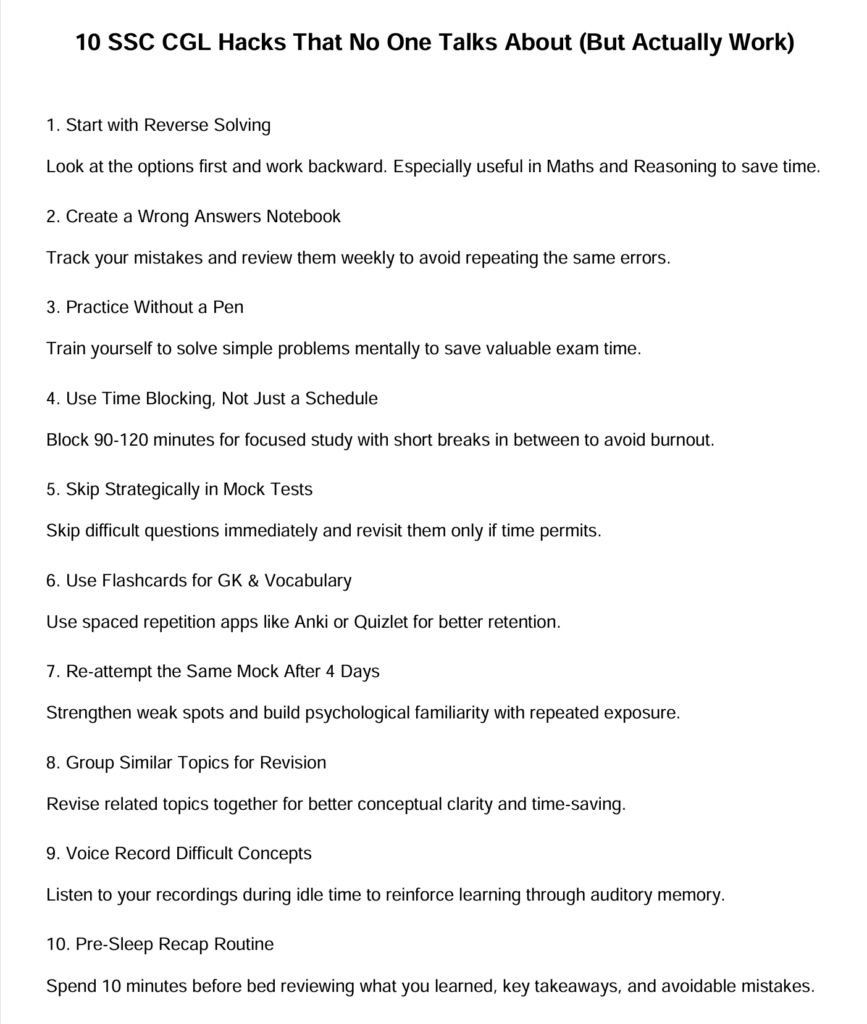
10 SSC CGL Hacks That No One Talks About (But Actually Work)

When it comes to cracking SSC CGL, most advice sounds the same: “Make a timetable”, “Practice previous year papers”, or “Revise regularly.” While these are important, they’re not the full story. Toppers often rely on lesser-known tactics that give them an edge—subtle, smart, and often underutilized. In this blog, we’ll uncover 10 SSC CGL hacks that are rarely discussed but actually help you improve speed, accuracy, and confidence.

1. Start with Reverse Solving

Instead of solving questions from scratch, try reverse solving—look at the options first, and work backward. Especially useful in Maths and Reasoning, this hack often saves time when the question has multiple steps.

Use it for: Profit & Loss, SI & CI, and Number Series.

2. Create a Wrong Answers Notebook

Most aspirants only maintain a formula or concept notebook. But one of the 10 SSC CGL hacks that smart students follow is maintaining a “Mistake Log” where every silly mistake, wrong guess, or misunderstood concept is recorded. Reviewing this notebook weekly helps in eliminating repeat errors.

3. Practice Without a Pen

Sounds weird? It’s not. Train your brain to solve simple calculations or logic steps without writing. This is a time-saving skill that adds up during the exam. Try solving 5–10 Quant/Reasoning questions daily using mental math only.

4. Use Time Blocking, Not Just a Schedule

Instead of planning each hour, block 90–120 minutes for focused study sessions. Between these blocks, schedule 15–20 minutes of active rest. This hack maximizes retention and prevents burnout—especially during long prep days.

5. Skip Strategically in Mock Tests

Here’s one of the smartest 10 SSC CGL hacks: You don’t have to attempt every question in order. In mocks, skip tough questions immediately and come back only if time permits. This not only boosts speed but also keeps your confidence high during the paper.

6. Use Flashcards for GK & Vocabulary

Instead of long static notes, make digital flashcards using tools like Anki or Quizlet. Spaced repetition and visual recall will help you retain General Awareness facts and tough English words without rereading bulky content.

7. Re-attempt the Same Mock After 4 Days

Don’t just move from one mock test to another. One of the most effective 10 SSC CGL hacks is to reattempt the same mock after a gap. This time, aim for 100% accuracy. It helps strengthen weak spots and builds psychological familiarity with exam pressure.

8. Group Similar Topics for Revision

Don’t revise topics in isolation. For example, revise “Time & Work”, “Pipes & Cisterns”, and “Boats & Streams” together—they follow similar logic. This grouping improves conceptual clarity and saves time.

9. Voice Record Difficult Concepts

Record yourself explaining tough concepts or vocabulary. Listen to them during travel, breaks, or while doing chores. This technique boosts auditory memory and is one of those 10 SSC CGL hacks ideal for auditory learners.

10. Pre-Sleep Recap Routine

Before going to bed, spend 10 minutes recalling:

  • What you studied today
  • 3 key things you learned
  • 1 mistake you won’t repeat

This reflection creates long-term retention and gives your brain a “learning closure” for the day.

Final Thoughts!

These 10 SSC CGL hacks might not be in every book or YouTube video, but they’re tried, tested, and proven by thousands of serious aspirants. The trick is not to do more, but to do it smarter.

Even if you implement just 3–4 of these consistently, your efficiency will improve drastically over the next few weeks.

Ready to Upgrade Your Mock Strategy?

Use the NetPractice App to get mock tests tailored to your weak areas, with in-depth analysis and timed practice. It’s the perfect companion for applying these 10 SSC CGL hacks effectively.

Also, here’s a picture for you to print and stick on your study table so you won’t forget 😉

You Might Also Like to Read –

SSC CGL Shift-Wise Analysis Archive

https://netpractice.app/ssc-cgl-shift-wise-analysis-archive/

SSC CGL Mock Test: How to Bounce Back After a Bad One

Why One Bad Mock Test Isn’t the End?

Let’s get one thing straight—a bad mock test result doesn’t define your SSC CGL journey. It’s natural to feel frustrated, demotivated, or even question your preparation. However, the most successful candidates are those who know how to bounce back after a bad SSC CGL mock test setback.

What matters more than the score is how you respond. Here’s a guide to help you reset, reframe, and return stronger.

Step 1: Don’t Panic—Pause and Reflect

The first rule? Don’t spiral into self-doubt. One low score does not erase all the hard work you’ve done. Instead, give yourself a moment. Let your emotions settle. This emotional pause is necessary so that your brain can switch from reacting to reflecting.

Ask Yourself:

  • Was this a particularly tough mock?
  • Was I tired, distracted, or unwell during the test?
  • Have my scores been inconsistent or was this just a one-off?

Step 2: Deep Dive into Analysis (Not Just Score Review)

The true value of a mock test lies not in the number but in the insights it gives. To bounce back after a mock test, you need to analyze it in layers.

Use this checklist for analysis:

  • Time per section: Did you rush or get stuck?
  • Accuracy vs Attempt: Were you guessing?
  • Error patterns: Similar mistakes in certain topics?
  • Silly mistakes vs Conceptual gaps

Write down three specific improvements based on the mock—this makes your next attempt more focused and intentional.

Step 3: Targeted Revision Before the Next Mock

Now that you know your weak zones, it’s time for micro-revision. Instead of rereading entire topics, focus on:

  • Re-attempting incorrect questions
  • Solving 10–15 similar level questions on those topics
  • Reviewing formulas or grammar rules that caused confusion

This targeted approach saves time and directly improves your mock performance.

Step 4: Don’t Stop Taking Mocks

Here’s where many aspirants go wrong—they take a break from mocks after a poor performance. But to bounce back after mock test failures, consistency is key.

Keep attempting mocks but with these rules:

  • Don’t chase scores—chase learning outcomes
  • Alternate between full-length mocks and sectionals
  • Track score trends weekly, not daily

Step 5: Rebuild Confidence with Small Wins

Confidence is often the first casualty of a bad mock. Regain it with small, consistent wins:

  • Solve 10 easy Quant or English questions correctly in a row.
  • Time yourself and improve accuracy in a mini test.
  • Re-attempt the same mock after 3–4 days and compare scores.

These actions help rewire your mindset from “I’m stuck” to “I’m improving.”

Step 6: Use a Support System

Sometimes, the best way to bounce back is to talk it out. Discuss the mock with:

  • A mentor
  • A study buddy
  • A community/forum like Reddit or Telegram SSC groups

Others might offer fresh perspectives or tips you hadn’t considered.

Final Thoughts: Growth Over Perfection

Bad mocks are not failures—they’re feedback. If you’re learning from every mistake and improving your next step, you’re on the right track.

The SSC CGL exam is not just a test of knowledge but of resilience and strategy. So, don’t let one bad day define your outcome.

Pro Tip:

Looking for a smarter way to improve? Use the NetPractice App to take structured, real-exam-level mocks and track your weak areas. It’s built to help you bounce back faster and smarter after every attempt.

Also Read –

How Many SSC CGL Mock Tests You Should Attempt?

https://netpractice.app/ssc-cgl-mock-tests-how-many-to-attempt/

SSC CGL Exam Checklist – What to Bring & What to Avoid

Why an SSC CGL Exam Checklist Is Essential?

As the SSC CGL exam date approaches, even well-prepared candidates can feel anxious—not just about the questions, but about the logistics of exam day. Having a clear and reliable SSC CGL exam checklist can save you from unnecessary stress and ensure that your focus stays where it matters—on solving the paper.

SSC CGL Exam Checklist: Things to Bring

Here’s a list of must-carry items for your SSC CGL exam:

1. Admit Card/ Hall Ticket

  • Printed copy of the SSC CGL Admit Card is mandatory.
  • Ensure all details (name, photo, exam center) are clearly visible.
  • Download it from the official SSC website (https://ssc.gov.in/) before the deadline.

2. Valid Photo ID Proof

Carry original and valid ID proof from the list below:

  • Aadhaar Card
  • Voter ID
  • Passport
  • Driving License
  • PAN Card

Note: The name and DOB should match what’s on your admit card.

3. Two Passport-Sized Photographs

  • Keep 2 recent passport-sized photos (preferably the same as uploaded).
  • Required for verification and backup if your ID photo is unclear.

4. Transparent Pen & Stationery

  • Carry at least 2 black or blue ballpoint pens.
  • Transparent body pens only (strictly no gel or fancy pens).

Things to Avoid in the SSC CGL Exam Hall

To maintain transparency and discipline, SSC has clearly stated what not to bring. Here’s what you must leave at home:

1. Electronic Gadgets

  • No mobile phones, smartwatches, earphones, fitness bands, Bluetooth devices, calculators, or digital watches are allowed.
  • Even switching them off won’t help—you could be debarred.

2. Bags or Big Pouches

  • Large handbags, purses, backpacks, or folders are not permitted inside the exam room.
  • Some centers may allow depositing them at your own risk, but it’s best not to carry them at all.

3. Notes, Papers, or Books

  • Carrying study material into the exam hall is considered malpractice.
  • Even a rough paper could cause suspicion—avoid carrying any extra paper.

4. Food or Beverages

  • Unless you have a medical condition with proof, you’re not allowed to bring snacks or drinks.
  • Water bottles should be transparent and label-free.

Bonus Tips for a Smooth Exam Day

  • Reach your center at least 60 minutes early to complete frisking and verification smoothly.
  • Dress comfortably but modestly—avoid jewelry, belts with large buckles, or shoes with metal parts.
  • Use the restroom before entering the exam hall, as breaks during the paper are not allowed.
  • Don’t forget to check your seat number and lab assignment at the center notice board.

Why This SSC CGL Exam Checklist Matters?

Every year, candidates are disqualified or delayed because of avoidable mistakes like missing documents or carrying banned items. This SSC CGL exam checklist ensures you are confident, compliant, and exam-ready—without any last-minute surprises.

Once you’re set with your SSC CGL exam checklist, focus on fine-tuning your practice. Download the NetPractice App to take final mocks, revise key concepts, and simulate real exam pressure. It’s your last-mile booster for success.

Also Read –

What To Do If You Get Stuck on a Question in SSC CGL?

https://netpractice.app/ssc-cgl-stuck-question-strategy/

SSC CGL Math – Arithmetic vs Advanced

Understanding SSC CGL Math: Arithmetic vs Advanced

When it comes to preparing for the Quantitative Aptitude section of SSC CGL, one common dilemma among aspirants is this: Should you focus more on Arithmetic or Advanced Math? Both are integral to scoring well, but the right approach depends on understanding their weightage, difficulty, and how you can maximize your marks based on your strengths.

In this blog, we’ll break down each part of SSC CGL Math, compare their importance, and help you decide where to put your energy during preparation.

What Comes Under SSC CGL Arithmetic?

Arithmetic in SSC CGL usually includes real-life math topics that test your numerical ability and basic logic. Some of the key topics are:

  • Percentage
  • Profit and Loss
  • Simple and Compound Interest
  • Ratio and Proportion
  • Averages
  • Time, Speed and Distance
  • Time and Work
  • Mixture and Alligation
  • Partnership
  • Boats and Streams

Why Is Arithmetic Important?

  • Covers practical math concepts relevant for day-to-day reasoning.
  • Questions are less formula-heavy and more logic-based.
  • Easier to master with regular practice.
  • Often quicker to solve if you know shortcuts.

What Is Included in SSC CGL Advanced Math?

Advanced Math, on the other hand, is more abstract and involves higher-level concepts. Topics include:

  • Algebra
  • Geometry
  • Mensuration (2D and 3D)
  • Trigonometry
  • Coordinate Geometry (basic)
  • Number System (with deeper concepts)

Why Is Advanced Math Important?

  • Though tougher, it carries a significant weightage in Tier 1 and Tier 2.
  • Requires conceptual clarity and memorization of formulas.
  • High scoring for those who practice regularly.

SSC CGL Math Weightage (Tier 1)

Here’s a general breakdown of the number of questions from each segment:

Topic TypeApprox. Questions
Arithmetic10–12
Advanced Math8–10

In Tier 2, this ratio is similar but the difficulty level increases, and the volume of questions nearly doubles. Hence, ignoring either section can seriously hamper your score.

Which Should You Focus On More?

1. Know Your Strengths

  • If you’re stronger in logical problem-solving, start with Arithmetic.
  • If you are comfortable with formulas and visual-spatial reasoning, Advanced Math may give you an edge.

2. Tier 1 Strategy

  • Prioritize Arithmetic initially because it’s easier to grasp and boosts confidence.
  • Gradually include key Advanced Math topics like Geometry and Algebra, which are frequently repeated.

3. Tier 2 Strategy

  • You cannot afford to skip either section in Tier 2.
  • Allocate equal time to both in mock tests and revision.

Useful Tips to Master SSC CGL Math

  1. Create a topic-wise formula sheet for both Arithmetic and Advanced Math.
  2. Use previous year papers to identify recurring questions.
  3. Focus on conceptual clarity—especially for Algebra, Geometry, and Trigonometry.
  4. Practice Arithmetic topics with speed and accuracy drills.
  5. Take full-length mock tests to manage time between the two sections effectively.

Final Verdict: Balance is Key

While SSC CGL Math may seem overwhelming at first, the key is to balance both Arithmetic and Advanced Math strategically. Start with your strong area, but don’t ignore the other. In the actual exam, scoring consistently across both sections gives you the best shot at a high overall score.

Need structured practice with both Arithmetic and Advanced Math? The NetPractice App offers topic-wise quizzes, timed mock tests, and real-time performance analysis tailored for SSC CGL aspirants. Download now and take your prep to the next level!

Also Read –

SSC CGL – Mastering Formulas & Calculations

https://netpractice.app/how-to-prep-for-ssc-cgl-qa-mastering-formulas-and-calculations/

SSC CGL Shift-Wise Analysis Archive

Why SSC CGL Shift-Wise Analysis Matters?

If you’re preparing seriously for SSC CGL, ignoring shift-wise analysis would be a mistake. Every year, the SSC CGL exam is conducted in multiple shifts across several days. While the paper pattern remains the same, question trends, difficulty level, and topic weightage vary slightly from shift to shift.

That’s where a shift-wise analysis archive becomes a valuable resource. It gives you data-driven insights into how the exam evolves over different days and sessions. Smart aspirants analyze this information to refine their preparation and gain a competitive edge.

What Is an SSC CGL Shift-Wise Analysis Archive?

An SSC CGL shift-wise analysis archive is a compilation of reviews and breakdowns of each exam shift—day-wise and time-slot-wise. It typically includes:

  • Topic distribution per section
  • Difficulty level of each section
  • Good number of attempts
  • Types of questions asked
  • Any surprises or pattern changes

This archive helps aspirants track trends over time and align their preparation accordingly.

What You Can Learn From It

Looking at multiple shifts over a week can reveal how SSC rotates certain question types. For instance, if algebra-based questions are appearing consistently in the Quant section across all shifts, it indicates a higher weightage.

2. Section-Wise Difficulty Level

By comparing difficulty levels across shifts, you can gauge which section is consistently tricky. For example, if English was easy on Day 1 but moderate on Days 2 and 3, you know to prepare for variability.

3. Frequently Asked Topics

A shift-wise archive will often highlight repetitive topics, such as:

  • Current Affairs questions focusing on specific months
  • Reasoning puzzles with similar logic
  • Grammar rules being repeatedly tested

This allows targeted revision.

4. Time Management Insights

Many shift reviews also include feedback on how much time aspirants spent per section. This helps you set a personal strategy when it comes to dividing your 60 minutes in Tier 1.

5. Good Attempts Benchmarking

Shift-wise data often mentions what was considered a “good number of attempts” in each slot. It gives you a clear picture of how many questions you should realistically aim to attempt while maintaining accuracy.

How to Use the Archive Effectively

  • Start from the most recent exam cycle and work your way backward.
  • Make note of high-frequency topics and unexpected questions.
  • Practice those questions using mock tests or topic-wise drills.
  • Use it to simulate actual shift conditions—e.g., attempt mock tests at the same time as the real shift you’re assigned.

Where to Find Reliable Shift-Wise Analysis

Look for trusted education platforms, forums, and YouTube educators who provide:

  • Day-wise written analysis
  • YouTube video breakdowns per shift
  • PDFs compiled from candidate reviews

Final Thoughts!

In a competitive exam like SSC CGL, even minor advantages can significantly impact your score. Using the SSC CGL shift-wise analysis archive smartly is one such edge. It helps you prepare more strategically, avoid surprises, and boost confidence going into the exam.

Before You Go–

Maximize your prep with NetPractice App—your one-stop solution for SSC CGL mock tests, personalized performance tracking, and real-time analysis based on actual shift data. Download now and stay one step ahead!

Also Read –

SSC CGL Hall Ticket Download

https://netpractice.app/ssc-cgl-2025-hall-ticket-download-guide/

How To Attempt Paper in 3 Rounds

https://netpractice.app/ssc-cgl-3-round-strategy-tier-1/

SSC CGL 2025 Hall Ticket: How to Download & Verify Details

Securing your SSC CGL 2025 Hall Ticket is a pivotal step in your examination preparation. This document not only grants you entry to the exam hall but also contains essential information about your test schedule and venue. Ensuring that you download and verify your admit card correctly can prevent last-minute complications. This guide provides a detailed walkthrough on how to obtain and authenticate your SSC CGL 2025 admit card.​

Understanding the Importance of the SSC CGL 2025 Admit Card

The SSC CGL admit card serves multiple purposes:​

  • Proof of Eligibility: Confirms your registration and eligibility to sit for the exam.​
  • Exam Details: Provides specifics such as exam date, time, and center location.​
  • Identity Verification: Facilitates identity confirmation at the exam venue.

Without this hall ticket, entry to the examination center is strictly prohibited.​

Step-by-Step Guide to Downloading Your SSC CGL 2025 Admit Card

Follow these steps to access your admit card:​

  1. Visit the Official SSC Website:
  2. Access the Admit Card Section:
    • On the homepage, click on the “Admit Card” tab.​
    • You’ll be redirected to a page listing regional SSC websites.
  3. Select Your Regional SSC Portal:
    • Choose the region corresponding to your application.​
    • Clicking the link will take you to the specific regional website.​
  4. Locate the Admit Card Download Link:
    • On the regional site, find the link titled “Download Admit Card for Combined Graduate Level Examination 2025.”​
  5. Enter Your Credentials:
    • Input your Registration Number/Roll Number and Date of Birth/Password.​
    • Ensure the details match those provided during registration.​
  6. Download and Print the Admit Card:
    • Once displayed, verify all details.​
    • Download and print multiple copies for future reference.​

Verifying Details on Your SSC CGL 2025 Admit Card

After downloading, meticulously check the following information:​

  • Personal Information:
    • Full Name​
    • Photograph​
    • Signature​
    • Date of Birth​
  • Exam Details:
    • Roll Number​
    • Application Number​
    • Exam Date and Time​
    • Reporting Time​
    • Exam Center Name and Address​
  • Important Instructions:
    • Items allowed/prohibited in the exam hall.​
    • COVID-19 guidelines (if applicable).​
    • Reporting procedures.

Note: Any discrepancies should be reported immediately to the respective regional SSC office for rectification.

Troubleshooting Common Issues

  • Forgotten Registration Number:
    • Use the “Forgot Registration Number” feature on the SSC website.​
    • Provide required details to retrieve your registration information.
  • Website Accessibility Problems:
    • Due to high traffic, the website may experience downtime.​
    • Attempt access during off-peak hours.​
    • Ensure a stable internet connection.​
  • Mismatch in Details:
    • Contact the regional SSC office promptly with supporting documents to correct errors.

Final Preparations Before Exam Day

  • Document Checklist:
    • Printed admit card.
    • Valid photo ID proof (Aadhar card, passport, etc.).​
    • Two recent passport-sized photographs.
  • Familiarize Yourself with the Exam Center:
    • Visit the location prior to the exam to estimate travel time.​
    • Plan to arrive at least 30 minutes before the reporting time.​
  • Adhere to Guidelines:
    • Follow the instructions mentioned on the admit card.​
    • Comply with any additional protocols specified by the SSC.​

Final Thoughts!

Efficiently downloading and accurately verifying your SSC CGL 2025 admit card is essential for a seamless examination experience. By following the outlined steps and ensuring all details are correct, you can focus on your preparation without unnecessary stress. Remember, the admit card is more than just a piece of paper—it’s your gateway to the examination hall and a step closer to your career aspirations.

Boost Your SSC CGL Preparation with NetPractice App!

Maximize your exam readiness by practicing with real exam-like mocks on the NetPractice App. Designed to simulate actual SSC CGL patterns, it helps you improve speed, accuracy, and confidence. Don’t just prepare—practice smart.

Download the NetPractice App today and start mastering SSC CGL with strategic mock tests!

Also Read –

Most Common SSC CGL FAQs!

https://netpractice.app/ssc-cgl-faqs-answering-the-most-common-queries/

SSC CGL Time Management: Solve 100 Questions in 60 Minutes

Cracking the SSC CGL Tier 1 exam is not just about what you know—it’s about how smartly you can apply it in a very short amount of time. You have exactly 60 minutes to solve 100 questions, spread across four sections: General Intelligence & Reasoning, General Awareness, Quantitative Aptitude, and English Comprehension. That leaves you just 36 seconds per question, which is where smart SSC CGL time management can make or break your score.

1. Know the Battlefield: Understand the Question Distribution

  • General Intelligence & Reasoning: 25 questions
  • General Awareness: 25 questions
  • Quantitative Aptitude: 25 questions
  • English Comprehension: 25 questions

Each section carries equal weightage, but not equal time demand. Quant and Reasoning are generally more time-consuming, while English and GK can be quicker if well-prepared.

2. Use the “60-30-10 Rule”

A unique way to break down the 60 minutes:

  • 60% of time (36 minutes): For Reasoning and Quant (approx. 18 min each)
  • 30% of time (18 minutes): For English and GK (approx. 9 min each)
  • 10% of time (6 minutes): Reserved for revision or solving skipped questions

This breakdown helps you stay aware of where you’re spending your time and when to move on.

3. Attempt in Waves: The Layered Approach

Instead of solving questions linearly, solve in three waves:

  • Wave 1 (First 25 mins): Attempt only the questions you are 100% sure of—your strong topics.
  • Wave 2 (Next 20 mins): Attempt medium difficulty questions that need 10–30 seconds of thinking.
  • Wave 3 (Last 15 mins): Tackle tougher questions if time allows. Prioritize sections where you still have time left.

This way, you secure the easy marks first and don’t lose time struggling.

4. Smart Elimination in GK and English

  • In GK, if unsure, eliminate the obviously wrong options.
  • In English, focus on keywords in passages or question stems.

These sections can be wrapped up fast if you stay sharp and don’t overthink.

5. Use Mental Marking

When doing the first pass (Wave 1), mentally mark questions you want to revisit later in Wave 2 or 3. Avoid re-reading all the questions. This trick saves at least 3–4 crucial minutes.

6. Train for Speed, Not Just Accuracy

  • Take sectional mock tests with a stopwatch.
  • Solve 25-question quizzes in 10–12 minutes.
  • Focus on calculation tricks for Quant (e.g., Vedic Math methods).

The goal is to reduce hesitation time while maintaining 80–90% accuracy.

7. Avoid Time Sinkholes

  • Don’t get emotionally attached to a tricky question.
  • If you’ve spent more than 40 seconds on one, skip and revisit.
  • Don’t try to solve puzzles or DI sets unless you’re confident about all questions in the set.

8. Always Leave Time for Revision

No matter what, keep the last 5–6 minutes free. Use it to:

  • Recheck marked questions
  • Correct silly errors
  • Attempt educated guesses

Final Thoughts!

The SSC CGL Tier 1 is a test of your preparation, mindset, and time management skills. By strategically dividing your paper, using wave-based solving, and training with mock tests, you’ll significantly improve your chances of attempting all 100 questions with good accuracy.

Want to practice under real-time pressure? Download the NetPractice App and start attempting full-length timed mock tests built exactly like the SSC CGL pattern. Build your timing muscle before exam day!

Also Read –

SSC CGL Best Timetable for Working Professionals

https://netpractice.app/ssc-cgl-study-timetable-for-working-professionals/

SSC CGL: How to Attempt the Paper in 3 Rounds (Tier 1 Strategy)

Cracking the SSC CGL Tier 1 exam is all about speed, accuracy, and smart strategy. With just 60 minutes to attempt 100 questions across four sections, aspirants often struggle with time management. One highly effective and tried-and-tested method is the 3-round strategy for SSC CGL Tier 1. This approach not only enhances your performance but also minimizes negative marking.

Why Use the 3-Round Strategy?

The 3-round strategy allows you to structure your approach during the exam, so you don’t waste time on difficult questions early on. Instead of going question by question in a linear way, this technique helps you:

  • Prioritize easy and scoring questions first
  • Manage time effectively
  • Reduce exam anxiety
  • Avoid getting stuck

The focus keyword here is 3-round strategy because it is central to your SSC CGL Tier 1 preparation plan.

Round 1: The Quick Pick Round (15-20 Minutes)

In this round, your goal is to answer all the easy and direct questions that you can solve in under 30 seconds. These questions are your quick wins and help build early momentum.

How to approach Round 1:

  • Start with your strongest section (for many, it’s General Awareness or English)
  • Skip any question that requires calculation or deep thinking
  • Mark doubtful ones for review

This round should give you at least 40-50% of your total score without spending much time.

Round 2: The Moderate Round (25-30 Minutes)

Now that the low-hanging fruit is done, focus on moderate-level questions. These take more time but are still doable with proper effort.

How to approach Round 2:

  • Return to marked questions from Round 1
  • Tackle questions that need some calculation or logical reasoning
  • Ensure you are not overthinking or spending more than 60 seconds per question

In this round, aim to solve 30-35 more questions, bringing your attempted total to around 70-80.

Round 3: The Risk Round (5-8 Minutes)

This is the time to revisit the most difficult or doubtful questions. Be selective and strategic. If you’re unsure of the answer, it’s often best to skip rather than risk a wrong attempt.

How to approach Round 3:

  • Re-attempt only those questions where you’re at least 60-70% confident
  • Avoid guesswork unless you have eliminated 2-3 options
  • Use any remaining time to double-check calculation-based questions

This round should help you pick up 5-10 extra marks, without risking much.

Section-Wise Tips for SSC CGL Tier 1 Strategy

  • General Awareness: Attempt in Round 1 if you’re well-prepared. These questions are direct and take very little time.
  • Reasoning: Mix of Round 1 and Round 2. Pattern-based and series questions go in Round 1; puzzles in Round 2.
  • Quantitative Aptitude: Time-consuming. Save tougher ones for Round 2 and Round 3.
  • English Comprehension: Vocabulary and grammar go in Round 1; comprehension passage in Round 2.

Final Thoughts

The 3-round strategy for SSC CGL Tier 1 is a game-changer when used correctly. It balances speed and accuracy, allowing you to maximize your score while avoiding silly mistakes. Practice this method regularly in mock tests to make it second nature.

Want to master this strategy with real-time practice? Download the NetPractice app and take smartly designed mock tests that help you implement the 3-round strategy effectively. Practice smarter, not harder!

Also Read –

How to Solve More Question Faster in SSC CGL

https://netpractice.app/ssc-cgl-solve-more-questions-faster/

SSC CGL Revision : Top 50 One Liners for Last-Minute Revision

When the SSC CGL exam is around the corner, last-minute revision becomes the most crucial part of your strategy. Rather than flipping through lengthy notes, focused one liners can help you retain maximum information in minimum time. In this blog, we’ve compiled 50 high-yield SSC CGL one liners covering static GK, current affairs, history, geography, polity, and science.

General Awareness & Polity

  1. Article 32 is the heart and soul of the Indian Constitution (Right to Constitutional Remedies).
  2. Fundamental Duties are listed in Article 51A.
  3. The 42nd Amendment is known as the Mini Constitution.
  4. Indian Parliament is bicameral – Lok Sabha and Rajya Sabha.
  5. Panchayati Raj was constitutionalized by the 73rd Amendment Act.
  6. The President is elected by an electoral college.
  7. The Supreme Court has the power of Judicial Review.
  8. Election Commission is an autonomous constitutional body.
  9. Finance Commission is constituted every five years.
  10. The 103rd Amendment introduced 10% EWS reservation.

Indian History

  1. The First Battle of Panipat was fought in 1526.
  2. The Quit India Movement started in 1942.
  3. Mahatma Gandhi returned to India in 1915 from South Africa.
  4. The Simon Commission came to India in 1928.
  5. The Cabinet Mission arrived in India in 1946.
  6. The Indian National Congress was founded in 1885.
  7. Subhash Chandra Bose founded INA in 1943.
  8. Dandi March was part of the Salt Satyagraha.
  9. The Jallianwala Bagh massacre happened in 1919.
  10. The battle of Buxar was fought in 1764.

Geography

  1. The Tropic of Cancer passes through 8 Indian states.
  2. India’s longest river is the Ganges.
  3. Rajasthan is the largest state by area.
  4. The Western Ghats are a UNESCO World Heritage site.
  5. The Sundarbans are the largest tidal halophytic mangrove forest.
  6. Majuli is the largest river island in the world.
  7. The highest peak in India is Kangchenjunga.
  8. The Indian Standard Meridian passes through Allahabad.
  9. Chilika Lake is Asia’s largest brackish water lagoon.
  10. The Thar Desert is located in the northwest part of India.

General Science

  1. Blood is filtered in the kidneys through nephrons.
  2. Newton’s First Law is the Law of Inertia.
  3. DNA carries genetic information.
  4. Iron’s chemical symbol is Fe.
  5. HCl is present in human stomach.
  6. The speed of light is approximately 3 x 10^8 m/s.
  7. Water is known as the universal solvent.
  8. Insulin regulates blood sugar levels.
  9. Plants produce oxygen during photosynthesis.
  10. The ozone layer is found in the stratosphere.

Current Affairs & Economy (2023-24 based)

  1. Chandrayaan-3 landed on the Moon in August 2023.
  2. G20 Summit 2023 was held in New Delhi.
  3. India overtook the UK as the 5th largest economy in 2023.
  4. Rajiv Kumar is the current Chief Election Commissioner (as of 2024).
  5. RBI’s repo rate is key to controlling inflation.
  6. The new Parliament building was inaugurated in May 2023.
  7. India’s digital payment system UPI is globally recognized.
  8. The Jal Jeevan Mission aims for safe drinking water in rural India.
  9. Ayushman Bharat is the world’s largest government health scheme.
  10. The Agnipath Scheme is for short-term recruitment in Indian Armed Forces.

How to Use These SSC CGL One Liners Effectively

  • Break them into sections and revise one section every day.
  • Convert them into flashcards using apps or physical cards.
  • Use the NetPractice app to take daily one-liner and GK quizzes.
  • Group similar facts together to build mental associations.
  • Revise these during travel, short breaks, or before sleep for better retention.

Final Thoughts!

These 50 SSC CGL one liners can save you time and boost your recall power significantly. They serve as a compact revision tool for the final days before the exam. Use them wisely and revise regularly to reinforce your memory.

Want to revise even faster? Download the NetPractice App and access quizzes, flashcards, and daily mock tests designed specially for SSC CGL aspirants like you. Smart revision starts here.

Also Read –

What to do if you get Stuck on SSC CGL Question?

https://netpractice.app/ssc-cgl-stuck-question-strategy/

How to Crack SSC CGL in 60 Days?

https://netpractice.app/ssc-cgl-tier-1-60-day-study-plan/